Spring Calculator | Constant, Deflection & Stress Tool
A tool for calculating the spring constant and deflection of a spring. Input the shear modulus, wire diameter, mean coil diameter, and active coils to calculate the spring constant k = Gd⁴/(8D³n), then enter a load to compute deflection δ = F/k. An interactive diagram shows the spring shape changing in real time.
Calculate spring constant from shear modulus, wire diameter, coil diameter, and active coils. Compute deflection and stress for a given load. Free online tool.
How to Use
- Enter the shear modulus G. Use 78.5 GPa for piano wire or 69 GPa for stainless steel as a guideline.
- Enter the wire diameter d, mean coil diameter D, active coils n, and free length L₀.
- Enter the load F to calculate the spring constant k, deflection δ, and loaded coil body length.
- The diagram updates in real time to visualize the spring deformation.
What Is Spring Constant?
The spring constant (spring rate) is the force required to displace a spring by 1 mm (or 1 m). In Hooke's law F = kδ, the proportionality constant k is the spring constant. It is expressed in units of N/mm or N/m.
The spring constant of a coil spring is determined by four parameters: the material's shear modulus G, wire diameter d, mean coil diameter D, and number of active coils n.
When G is in MPa (standard textbook form)
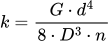
When the shear modulus G is given in MPa (= N/mm²), substituting directly yields k in N/mm.
When G is in GPa (this tool's input unit)
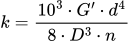
When G' is given in GPa, the conversion factor 10³ (since 1 GPa = 10³ MPa) is multiplied in the numerator. This tool handles the conversion automatically.
- k [N/mm] : Spring Constant k
- G [MPa] : Shear modulus (MPa = N/mm²)
- G' [GPa] : Shear modulus (GPa) — this tool's input unit
- d [mm] : Wire Diameter d
- D [mm] : Mean Coil Diameter D
- n : Active Coils n
From this formula, increasing the wire diameter raises the spring constant by the 4th power, while increasing the mean coil diameter decreases it by the 3rd power.
Deflection is found from Hooke's law δ = F/k. Once the load F is known, dividing by the spring constant k gives the extension, allowing you to back-calculate wire and coil diameters from the required stroke during design.
What Is Shear Stress?
When a load is applied to a coil spring, shear stress develops across the wire cross-section. Shear stress is the most fundamental metric for evaluating spring strength — if it exceeds the allowable stress, the spring will permanently deform or fracture.
Spring shear stress can be calculated from three parameters: load, mean coil diameter, and wire diameter. The smaller the wire diameter or the larger the coil diameter, the higher the stress.
Shear Stress Formula
The basic shear stress of a coil spring is given by the following formula.

- τ [MPa] : Shear Stress τ
- F [N] : Load F
- D [mm] : Mean Coil Diameter D
- d [mm] : Wire Diameter d
Wahl Correction Factor and Corrected Shear Stress
In an actual coil spring, stress concentrates on the inner side of the coil. The Wahl correction factor K accounts for this stress concentration. It is calculated using the spring index c = D/d as follows.

Multiplying the basic shear stress by the Wahl correction factor gives the corrected shear stress τ'.

The smaller the spring index c (i.e., the coil diameter is small relative to the wire diameter), the larger the correction factor becomes, meaning more severe stress concentration on the inner coil. Fatigue strength evaluation typically uses this corrected shear stress.
Spring Design Considerations
After calculating the spring constant, it is helpful to check the following points when selecting or designing a spring.
Spring Index and Wahl Correction Factor
The spring index c = D/d describes the coil geometry. If c is too small, coiling becomes difficult; if too large, the coil shape becomes unstable.
According to JIS B 2704 (Design and testing of compression and tension coil springs), c = 4–22 is the acceptable manufacturing range, and c = 6–12 is preferred for mechanical design.
A smaller spring index (coil diameter small relative to wire diameter) concentrates stress on the inner side of the coil. Excessive stress concentration leads to fatigue failure or permanent set at that point. The Wahl correction factor K quantifies this effect: K = (4c − 1) / (4c − 4) + 0.615 / c. Multiplying the calculated shear stress by K gives the corrected shear stress, which is compared against the allowable stress to verify safety.
Materials and Shear Modulus
The shear modulus of the spring material directly affects the spring constant. Select the appropriate material based on the operating environment (temperature, corrosion, magnetism). The values below are typical values based on JIS B 2704 appendix tables.
| Material | Shear Modulus G [GPa] |
|---|---|
| Piano Wire (SWP) | 78.5 GPa |
| Hard Steel Wire (SWC) | 78.5 GPa |
| Stainless Steel Wire (SUS304) | 69 GPa |
| Phosphor Bronze Wire | 42 GPa |
| Beryllium Copper Wire | 48 GPa |
| Inconel X-750 | 79 GPa |
Fatigue Life
Springs under cyclic loading require attention to fatigue failure. Keep the maximum shear stress below the material's allowable shear stress, and apply surface treatments such as shot peening to improve fatigue strength. In springs, stress concentrates at the hook root, making hook shape selection important. For details on how shot peening works, see "How can I improve spring fatigue life?" in the FAQ section below.
Spring Calculation Examples
Springs are widely used to pull components back with restoring force. Below are calculation examples with applications suited to each material's properties. Piano wire is suited for machine parts requiring high strength, stainless steel for outdoor environments requiring corrosion resistance, and phosphor bronze for electronic devices requiring non-magnetic and conductive properties.
| Application | Material | G [GPa] | d [mm] | D [mm] | n | k [N/mm] |
|---|---|---|---|---|---|---|
| Return spring for machine parts | Piano Wire (SWP) | 78.5 | 4 | 40 | 50 | 0.79 |
| Spring for outdoor equipment | Stainless Steel (SUS304) | 69 | 1.6 | 12 | 15 | 2.18 |
| Spring in electronic devices | Phosphor Bronze Wire | 42 | 6 | 50 | 20 | 2.72 |
The above are calculation examples using this tool. Select materials based on the operating environment (temperature, corrosion, magnetism, etc.).
Frequently Asked Questions
- What is the formula for spring constant?
- The spring constant of a spring is calculated as k = Gd⁴/(8D³n), where G is the shear modulus, d is the wire diameter, D is the mean coil diameter, and n is the number of active coils.
- What is the shear modulus?
- The shear modulus (modulus of rigidity) represents a material's resistance to shear deformation. For piano wire it is approximately 78.5 GPa, and for stainless steel approximately 69 GPa.
- What is the mean coil diameter?
- The mean coil diameter is the average of the outer and inner diameters: D = (OD + ID) / 2. It also equals the outer diameter minus the wire diameter.
- How do you count active coils?
- Active coils are the coils that contribute to spring deflection — the total coils minus dead coils. For springs with hooks, active coils are the coil body count excluding the hooks.
- What is the difference between tension and compression springs?
- Tension springs resist pulling loads and have hooks at each end. Compression springs resist pushing loads and have ground flat ends. The basic spring constant formula is the same, but tension springs require additional consideration of hook stress concentration and initial tension.
- What is the recommended spring index (D/d) range?
- The spring index c = D/d should be between 4 and 22 for manufacturability. Below 4, coiling becomes difficult; above 22, the coil shape becomes unstable. For mechanical components, a range of 6 to 12 is commonly used.
- How can I improve spring fatigue life?
- Shot peening is a process where small steel balls are blasted at high speed onto the spring surface. This creates compressive residual stress on the surface. Fatigue failure occurs when tensile stress causes microscopic surface cracks to grow, but pre-existing compressive stress on the surface suppresses crack initiation and propagation, thus improving fatigue life. Additionally, designing the spring index within the proper range (around 4–12) to minimize stress concentration, and keeping the maximum shear stress within 60–80% of the allowable shear stress, are also effective measures.
Gear Ratio Calculator
In mechanical design, gear selection is as important as spring selection. Use the gear ratio calculator for gear specifications.