Milling Feed Per Tooth (fz) Calculator
A tool for calculating feed per tooth (fz) in milling operations from spindle speed, table feed rate, and number of flutes. Visualize cutting mechanics with a real-time trochoidal path animation.
Calculate feed per tooth fz = vf/(z×n) from spindle speed (n), table feed (vf), and number of flutes (z). Free online tool with trochoidal path animation.
* Schematic trochoidal path (top view). The bracket shows the x-direction spacing on the cutting line = definition of fz. Scale is exaggerated.
InverseTable feed at this fz
fz(0.0500) × z(4) × n(1000) =
vf = 200.0 mm/min
Reverse-calculate in Table Feed Rate (vf) tool →How to Use
- Set the spindle speed using the "n Spindle Speed" slider or number input (200–40,000 min⁻¹).
- Set the table feed rate using the "vf Table Feed" slider or number input (10–1,000 mm/min).
- Select the number of flutes using the "z" buttons (2–8).
- The calculated fz value is displayed in real time on the right. The trochoidal path animation on the left visualizes each cutting edge's path.
What is Feed Per Tooth (fz)?
Feed per tooth (fz) is a parameter that represents the distance each cutting edge advances in the feed direction during one revolution of the end mill. It is expressed in mm/tooth (mm/t.).
fz directly affects surface finish quality, tool life, and chip evacuation. A larger fz increases chip thickness and improves machining efficiency, but also increases the load on the cutting edge. Conversely, if fz is too small, friction (rubbing) dominates over actual cutting, causing abnormal temperature rise at the cutting edge and accelerating wear.
In CNC machining programs, the table feed rate vf (mm/min) is the commanded value, so fz is not directly entered. However, when designing machining conditions, the standard procedure is to determine vf from fz using the formula vf = fz × z × n.
Formula and Variable Definitions
fz is calculated by dividing the table feed rate (vf) by the product of the number of flutes (z) and the spindle speed (n).
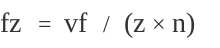
The meaning of each variable is as follows:
| Variable | Unit | Meaning |
|---|---|---|
| fz | mm/t. | Feed per tooth — distance each cutting edge advances per revolution |
| vf | mm/min | Table feed rate — distance the workpiece moves per minute in the feed direction |
| z | — | Number of flutes — number of cutting edges on the end mill |
| n | min⁻¹ | Spindle speed — number of revolutions per minute of the end mill |
Rearranging this formula gives vf = fz × z × n, allowing you to back-calculate the required table feed rate from a target fz. The standard procedure in practice is to combine the recommended fz from machining condition tables with the recommended spindle speed from the tool catalog to determine the appropriate feed rate.
Reference fz Values by Workpiece Material
The following are typical fz reference values when using a solid carbide end mill (approx. φ10). Actual values vary depending on depth of cut, tool overhang length, and coolant conditions.
| Workpiece Material | fz Reference [mm/t.] |
|---|---|
| Aluminum Alloy (A5052, etc.) | 0.05 – 0.20 |
| Carbon Steel (S45C, etc.) | 0.05 – 0.15 |
| Stainless Steel (SUS304, etc.) | 0.03 – 0.10 |
| Cast Iron (FC250, etc.) | 0.08 – 0.25 |
| Titanium Alloy (Ti-6Al-4V, etc.) | 0.03 – 0.08 |
| Copper Alloy (C3604, etc.) | 0.05 – 0.15 |
* The above are reference values for solid carbide end mills (φ10). Values vary significantly depending on tool diameter, coating, and cutting conditions. Always verify with the tool manufacturer's catalog.
For HSS end mills, fz should generally be set 20–50% lower than carbide values. Additionally, fz may need to be further reduced for long cutting-edge tools or deep slot machining to account for tool deflection.
Real-World Machining Examples
Here are three representative calculation examples using this tool. All use solid carbide end mills (φ10).
| Operation | Material | Tool Dia. | z | vf [mm/min] | n [min⁻¹] | fz [mm/t.] |
|---|---|---|---|---|---|---|
| Aluminum alloy side milling | A5052 | φ10 | 3 | 1,080 | 12,000 | 0.030 |
| Carbon steel slot milling (roughing) | S45C | φ10 | 4 | 600 | 3,000 | 0.050 |
| Stainless steel finish milling | SUS304 | φ10 | 4 | 320 | 2,000 | 0.040 |
Aluminum alloys can be machined stably at high speeds and feeds. Stainless steel is prone to work hardening, so lower spindle speeds and feeds are required to ensure proper chip evacuation.
fz and Surface Roughness
Milled surfaces retain a theoretical roughness (cusp height) determined by the feed pitch. If the corner radius of the end mill is R and feed per tooth is fz, the theoretical roughness Rth is approximated by Rth ≈ fz² / (8R). Doubling fz quadruples Rth.
For finishing operations targeting Ra 0.8 μm or less, fz is typically held below 0.02 mm/t. with a large corner radius tool. In roughing, material removal rate takes priority, so fz is pushed toward the catalog upper limit.
From a tool life perspective, higher fz increases mechanical and thermal load on the cutting edge, accelerating flank wear. However, excessively low fz causes rubbing instead of cutting, which raises edge temperature and can actually shorten tool life. Each workpiece-tool combination has a lower fz threshold below which wear accelerates, so staying above the catalog minimum is just as important as not exceeding the maximum.
Frequently Asked Questions
- What is fz (feed per tooth)?
- It is the distance each cutting edge advances in the feed direction during one revolution of the end mill. Calculated as fz = vf ÷ (z × n).
- What happens when fz is too large?
- Chips become thicker and machining efficiency increases, but tool load increases, potentially shortening tool life and producing a rougher surface finish.
- How do I determine the appropriate fz value?
- It depends on the workpiece material, tool material, cutter diameter, and depth of cut. Refer to the recommended values in the tool manufacturer's catalog.
- What does the animation in this tool represent?
- It displays the trochoidal paths traced by each cutting edge of the end mill in a top view. The amber bracket shows the spacing between adjacent cutting points on the cutting line (= fz).
- What is the relationship between fz and cutting speed (Vc)?
- Cutting speed Vc is the peripheral speed of the cutter, calculated as Vc = π × D × n / 1000. The standard procedure is to determine the appropriate spindle speed n from Vc, then calculate the table feed as vf = fz × z × n.
- How do I choose the number of flutes?
- Fewer flutes (2–3) provide larger chip pockets and better evacuation, making them suitable for aluminum and deep slot machining. More flutes (4–6) result in a smaller fz at the same feed rate, improving surface finish — ideal for finishing operations and steel machining.
- What happens when fz is too small?
- The cutting edge fails to remove sufficient material, and friction (rubbing) dominates over actual cutting. This causes abnormal temperature rise at the cutting edge, accelerating wear and generating built-up edge that degrades surface finish quality.
Table Feed (vf) Calculator
Once you have determined fz, use the table feed calculator to compute vf = fz × z × n for your NC program F-code.
Spindle Speed (n) Calculator
Calculate spindle speed from cutting speed and tool diameter. Use this to determine the n value for fz calculation.