Milling Table Feed Rate (vf) Calculator
A tool for calculating the table feed rate (vf) in milling operations from feed per tooth, number of flutes, and spindle speed. Visualize cutting mechanics with a real-time trochoidal path animation.
Calculate table feed rate vf = fz × z × n from feed per tooth (fz), flute count (z), and spindle speed (n). Free online tool with trochoidal path animation.
* Schematic trochoidal path (top view). Shows fz bracket and vf = fz × z × n formula. Scale is exaggerated.
InverseFeed per tooth at this vf
vf(400.0) ÷ (z(4) × n(1000)) =
fz = 0.1000 mm/t.
Reverse-calculate in Feed per Tooth (fz) tool →How to Use
- Set the feed per tooth using the "fz" slider or number input (0.01–0.50 mm/t.).
- Select the number of flutes using the "z" buttons (2–8).
- Set the spindle speed using the "n" slider or number input (200–40,000 min⁻¹).
- The calculated vf value is displayed in real time on the right. The trochoidal path animation on the left visualizes the cutting process.
What is Table Feed Rate (vf)?
Table feed rate (vf) is a parameter that represents the distance the workpiece travels in the feed direction per minute during milling. It is expressed in mm/min and is the value directly commanded by the F code in CNC programs.
vf directly affects machining time and efficiency. A higher vf shortens machining time, but the load on each cutting edge (fz) increases proportionally, requiring a balance between tool life and surface finish quality.
vf is calculated as the product of fz (feed per tooth) × z (number of flutes) × n (spindle speed). By determining the recommended fz from the tool catalog and an appropriate spindle speed n for the machining conditions, the correct vf can be calculated.
Formula and Variable Definitions
vf is calculated by multiplying the feed per tooth (fz) by the number of flutes (z) and the spindle speed (n).
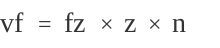
The meaning of each variable is as follows:
| Variable | Unit | Meaning |
|---|---|---|
| fz | mm/t. | Feed per tooth — distance each cutting edge advances per revolution |
| vf | mm/min | Table feed rate — distance the workpiece moves per minute in the feed direction |
| z | — | Number of flutes — number of cutting edges on the end mill |
| n | min⁻¹ | Spindle speed — number of revolutions per minute of the end mill |
Rearranging this formula gives fz = vf / (z × n). In CNC machining, the F code directly accepts vf, so pre-calculating the appropriate vf with this tool streamlines program creation.
Reference vf Values by Workpiece Material
The following are typical vf reference values when using a solid carbide end mill (approx. φ10). Values vary depending on the combination of fz, number of flutes, and spindle speed.
| Workpiece Material | vf Reference [mm/min] |
|---|---|
| Aluminum Alloy (A5052, etc.) | 200 – 2,000 |
| Carbon Steel (S45C, etc.) | 100 – 800 |
| Stainless Steel (SUS304, etc.) | 50 – 400 |
| Cast Iron (FC250, etc.) | 150 – 1,000 |
| Titanium Alloy (Ti-6Al-4V, etc.) | 30 – 250 |
| Copper Alloy (C3604, etc.) | 150 – 1,200 |
* The above are reference values for solid carbide end mills (φ10). Values vary significantly depending on tool diameter, coating, and cutting conditions. Always verify with the tool manufacturer's catalog.
For high-feed special end mills, vf values several times higher than the above may be achievable. For finishing operations, vf is typically reduced to 30–50% of roughing values.
Real-World Machining Examples
Here are three representative calculation examples using this tool. All use solid carbide end mills (φ10).
| Operation | Material | Tool Dia. | z | n [min⁻¹] | fz [mm/t.] | vf [mm/min] |
|---|---|---|---|---|---|---|
| Aluminum alloy side milling | A5052 | φ10 | 3 | 12,000 | 0.030 | 1,080 |
| Carbon steel slot milling (roughing) | S45C | φ10 | 4 | 3,000 | 0.050 | 600 |
| Stainless steel finish milling | SUS304 | φ10 | 4 | 2,000 | 0.040 | 320 |
Aluminum alloys can achieve high vf values due to stable machining at high feeds. Stainless steel requires lower fz, resulting in correspondingly lower vf values.
Table Feed Rate and Cycle Time
In CNC machining, the single biggest factor governing machining time is the feed rate vf. For a straight cutting pass, machining time is simply the cutting length L divided by vf (L / vf), so raising vf by 50% cuts that segment's time to roughly two-thirds.
Raising vf alone increases fz and changes the tool load. Since deflection and cutting resistance also shift with depth of cut ap and ae, a common alternative is to hold fz constant and increase vf by adding flutes z or raising spindle speed n.
Rapid traverse segments (G00) are unaffected by vf. If rapids make up a large share of the cycle, improving vf alone may not yield the expected reduction. Start by breaking down the cycle time and identifying the actual bottleneck.
Frequently Asked Questions
- What is vf (table feed rate)?
- It is the distance the workpiece travels in the feed direction per minute. Calculated as vf = fz × z × n, and directly entered as the F code in CNC programs.
- What happens when vf is too high?
- The load on each cutting edge (fz) increases, potentially causing tool breakage, chipping, and poor surface finish. Feed axis thrust limits of the machine should also be considered.
- What is the difference between vf and fz?
- fz is the distance each cutting edge advances per revolution, while vf is the distance the workpiece moves per minute. They are related by vf = fz × z × n. fz is the fundamental design unit for tool selection, while vf is the practical value commanded in CNC programs.
- What does the animation in this tool represent?
- It displays the trochoidal paths traced by each cutting edge of the end mill in a top view. The amber bracket shows the spacing between adjacent cutting points on the cutting line (= fz).
- How do I determine the spindle speed n?
- Calculate from cutting speed Vc and cutter diameter D using n = 1000 × Vc / (π × D). Recommended Vc values by workpiece material are listed in tool manufacturer catalogs.
- How does the number of flutes affect vf?
- With the same fz and n, increasing the number of flutes z proportionally increases vf. More flutes improve machining efficiency, but the smaller chip pockets require attention to chip evacuation.
- What happens when vf is too low?
- fz becomes extremely small, and friction (rubbing) dominates over actual cutting. This causes abnormal temperature rise at the cutting edge, accelerating wear and generating built-up edge that degrades surface finish quality.
Milling fz Calculator
A tool for back-calculating feed per tooth (fz) from table feed rate. Use it to verify machining conditions.
Spindle Speed (n) Calculator
Calculate spindle speed from cutting speed and tool diameter. Use this to determine the n value for vf calculation.